Your Metrics Tell Half Story
📊 As paid social influences behavior beyond its own metrics, content quality determines whether that demand converts.

Hey there 🧠
Ready for another day of staying ahead of the competition in the Growth race?
Oh and before we go ahead! If your friend sent this to you, be sure to subscribe here! So you don’t miss out on any editions.
Partnership with T-Mobile
Get 10 Voice Lines for $200 & $150 credit per new voice line*

Right now, pay just $20 line when you switch 10 or more lines on T-Mobile for Business CoreMobile plan.
Bring your device and keep your current numbers. Plus, get an additional $150/line back when you switch. No limit. Learn more now.
*10 lines for $200/mo; each additional line $20/mo./line with Autopay; plus taxes & $35 device connection charge. $150/line credit via one-time bill credit.
💡 Why Your Paid Social Looks Worse Than It Is
Paid social often gets judged in isolation. Low conversions, weak ROAS, and underwhelming dashboards make it look like it is underperforming. But that view misses a critical reality. Social does not just convert, it influences behavior across channels. If you measure it incorrectly, you undervalue it completely.
Here’s how to test its real impact.
1️⃣ Start With A Clear Hypothesis: Assume that increasing social spend will drive more branded searches and improve PPC performance. Social creates awareness that shows up elsewhere.
2️⃣ Use Geographic Split Testing: Increase social spend in selected regions while keeping others constant. Then compare PPC metrics like CTR and conversions across both groups.
3️⃣ Control External Variables Carefully: Regional factors like sponsorships, local campaigns, or commuting patterns can distort results. Choose test regions thoughtfully.
4️⃣ Ensure PPC Can Capture Demand: If social increases demand, your PPC campaigns must have enough budget to capture it. Otherwise, results get skewed.
5️⃣ Measure Beyond Platform Metrics: Look at cross channel performance, branded search volume, and conversion paths instead of relying only on platform dashboards.
6️⃣ Validate Results Critically: If results seem too extreme, question them. External factors can influence even well designed tests.
7️⃣ Real Impact Can Be Hidden: In one case, pausing social led to a major drop in conversions, even though individual channel metrics looked stable.
The Takeaway
Paid social is not just a conversion channel, it is a demand generator. If you measure it in isolation, you miss its real value. Test its influence across channels to understand its true impact.
💡 Why Most Content Teams Underperform
Many teams think better budgets or better tools will fix their content performance. But the real drivers of success are much closer to home. High performing content is not about external advantages, it is about how well your team executes internally.
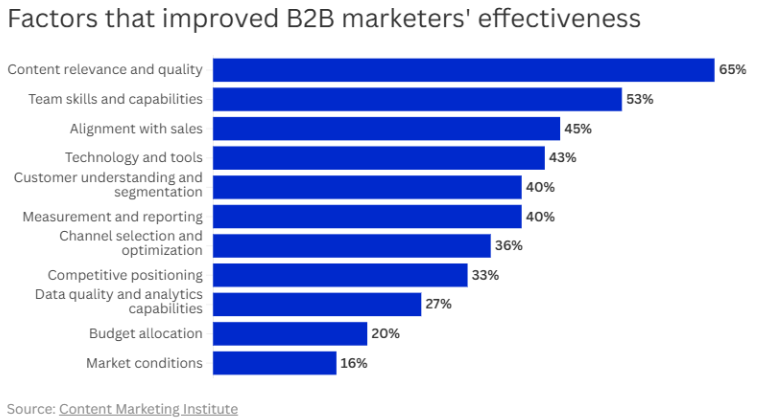
Here’s what actually moves the needle.
1️⃣ Relevance And Quality Lead Everything: Around 65% of marketers say content quality and relevance are the biggest drivers of performance. If content does not match user needs, nothing else matters.
2️⃣ Team Skill Determines Output: Over half of marketers highlight team capability as a key factor. Better strategy, writing, and execution directly improve results.
3️⃣ Sales Alignment Drives Conversions: Content works best when it connects directly to sales. Understanding objections and buyer stages helps create content that actually converts.
4️⃣ Tools Support Execution, Not Replace It: Technology helps streamline processes, but it cannot fix weak strategy or poor content decisions.
5️⃣ Budget Is Not The Main Constraint: Only 20% of marketers see budget as a major factor. This shows that performance is less about spending and more about execution.
6️⃣ Market Conditions Matter Less Than You Think: External factors like market trends rank even lower. Strong teams perform regardless of conditions.
7️⃣ Close The Feedback Loop: Using sales data, especially closed lost reasons, helps identify content gaps and improve future output.
The Takeaway
Content performance is not an external problem, it is an internal one. Teams that focus on skills, alignment, and execution consistently outperform those waiting for better budgets or conditions.
As we prepare more "Growthful" content, we'd love to hear your thoughts on today's edition! Feel free to share this with someone who would appreciate it. 🥰