When Innovation Scares Buyers
🔥 The future may be AI-built, but buyers still crave a human behind it.

Hey there 🧠
Ready for another day of staying ahead of the competition in the Growth race?
Oh and before we go ahead! If your friend sent this to you, be sure to subscribe here! So you don’t miss out on any editions.
Partnership with Galactic Fed
You've tried everything. You haven't tried this.

If you've tried everything and growth still isn't happening, there's probably one blind spot hiding in plain sight.
Galactic Fed finds it. Their team audits your site and channels, then hands you a custom blueprint built from managing millions in spend across 600+ eCommerce brands. Real people spend hours on your account before you even get on the call.
Here's what's inside:
- A channel audit showing exactly where your budget is underperforming
- A custom growth plan built from 600+ brands worth of real data
- Competitor breakdown with the specific moves to get ahead
HVMN grew organic site visitors 583% through a targeted SEO strategy. Ruby Love generated $600k in sales and grew revenue 300% through email. Both were built the same way your plan will be.
It's free, personalized, and slots are limited to 10.
💡 Should You Tell Customers Your Product Was Designed By AI?Insights from sciencesays
Using AI to create something innovative sounds like a marketing dream.Until you put “AI-designed” on the label and watch sales quietly collapse.
Brands are rushing to showcase AI involvement as a badge of innovation. But consumers do not always see it that way. In many cases, AI labeling reduces purchase intent instead of boosting it.
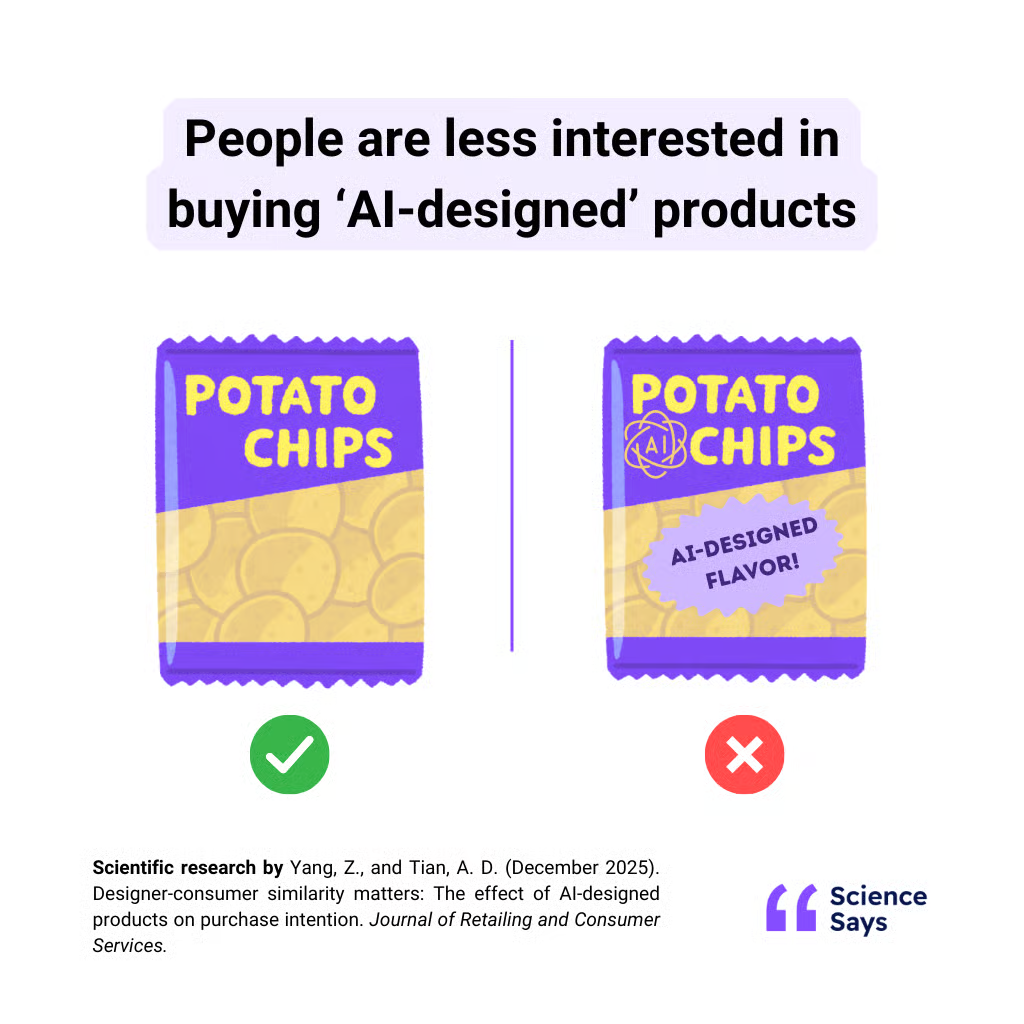
Here is what is really happening.
1️⃣ AI Labels Can Reduce Purchase Intent: Across multiple experiments on physical products like perfumes and snacks, products labeled “AI-designed” saw up to 28.8% lower purchase intention compared to human-designed versions. Consumers also assumed 75% less human involvement when AI was highlighted. When identity and emotional connection matter, this perception hurts.
2️⃣ Human-AI Collaboration Performs Better: When products were framed as human designers using AI as a tool, purchase intention increased. In fact, human-AI collaboration outperformed fully AI-designed products by 12.8% and even slightly outperformed purely human-designed products. Framing matters more than the tool itself.
3️⃣ Identity Drives the Reaction: Consumers prefer products that feel aligned with people like them. When AI is positioned as the creator, that human alignment disappears. However, when a named designer is clearly leading the vision and AI supports technical precision, customers retain that identity connection.
4️⃣ Utility Changes the Equation: Interestingly, when products were rented rather than purchased, AI-designed items performed better. In rental scenarios, consumers prioritize function over identity. Emotional alignment matters less than utility.
5️⃣ Communicate AI Strategically: If AI supports your process, position it as an enhancer, not the hero. Example: “Designed by Alex, enhanced with AI for technical precision.” Avoid “AI-designed” as the headline unless the category rewards technological innovation.
The Takeaway
AI can improve your product. But how you communicate its role determines whether it increases curiosity or kills conversion. Lead with human vision. Let AI play the supporting role.
💡 How To Make Purchase Decisions Easier For Shoppers
Sometimes your customer is not unconvinced.They are just unconvinced enough to hesitate.
At the final step of the funnel, logic takes a backseat and emotion drives the click. The right promotion does not just reduce price. It reduces doubt.
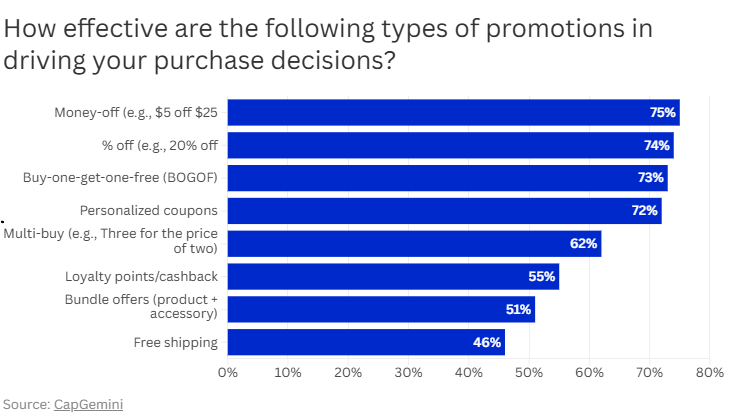
Here is what actually nudges people over the line.
1️⃣ Money-Off Discounts Deliver The Strongest Push: Straight dollar discounts like “$5 off $25” top the list, influencing 75% of shoppers. Percentage discounts follow closely at 74%. Hard-dollar savings feel concrete and immediate. The brain registers them as a clear win.
2️⃣ BOGO And Personalized Coupons Still Convert: Buy-one-get-one-free offers influence 73% of buyers, while personalized coupons impact 72%. These promotions feel tailored or amplified, increasing perceived value without necessarily slashing margins across the board.
3️⃣ Free Shipping Is Expected, Not Exciting: Only 46% rank free shipping as the most persuasive factor. It matters, but mostly as a baseline. It removes friction rather than creates urgency. A visible price cut, on the other hand, creates momentum.
4️⃣ The Psychology Behind It: Direct discounts create an instant dopamine hit. “I saved $20” feels more rewarding than “I avoided a $6 shipping fee.” One feels like a gain. The other feels like neutralizing a loss.
5️⃣ Match The Format To The Price Point: For products under $100, percentages often look more compelling. For higher-ticket items, specific dollar amounts feel more substantial. “Save $200” lands harder than “Save 10%.”
The Takeaway
Closing the sale is rarely about convincing someone your product is good. It is about giving them a reason to act now. The right discount reduces hesitation, increases perceived value, and turns intention into action.
As we prepare more "Growthful" content, we'd love to hear your thoughts on today's edition! Feel free to share this with someone who would appreciate it. 🥰