Turn searches into visits
📍How to rank higher on Google Maps, and why tracking confidence is falling.

Hey there 🧠
Ready for another day of staying ahead of the competition in the Growth race?
Oh and before we go ahead! If your friend sent this to you, be sure to subscribe here! So you don’t miss out on any editions.
Partnership with Modash
The Creator Strategy That Finally Scales

Ever wonder how some teams ship endless creator content without studio budgets or production chaos?
It’s rarely bigger teams. It’s co-creation done right.
Most brands rely on standard sponsored posts. One brief. One deliverable. One spike in performance. Then it stalls. That constant reset drains time, budget, and momentum.
Modash is hosting Gabriel Gomez, Head of Social and Creators at MCoBeauty, for a behind-the-scenes breakdown of the exact system they use to scale creator output without burning out their team.
In this session, you’ll learn:
- When co-creation beats a standard sponsored post, and why it compounds
- How MCoBeauty selects creators who can actually co-create at scale
- The low-lift production workflow that increases output without adding headcount
- How top teams measure co-creation performance beyond surface metrics
By the end, you’ll see how a clear co-creation model unlocks stronger performance and a creator pipeline that stays full.
No Hollywood crew required. Just a repeatable process that scales.
Can’t make it live? Register anyway, and we’ll send you the replay
💡 You Can Optimize Your Google Maps To Appear More In Search. Here’s How
Having a Google Business Profile is not enough. Like a gym membership, results only come if you use it properly.
Ahrefs outlines five core strategies to help local businesses rank higher when customers search for nearby services.
1️⃣ Perfect Your Google Business Profile Setup: Claim and verify your listing immediately. Choose the most accurate primary category, as it carries the most ranking weight. Complete every available field, including descriptions, services, hours, and high-quality photos. A fully optimized profile signals legitimacy and activity to Google.
2️⃣ Build Trust Through Consistent Reviews: Focus on generating a steady flow of authentic reviews rather than one large push. Respond to all feedback, especially negative comments, to demonstrate accountability. Consistent engagement improves trust and sends positive activity signals to Google.
3️⃣ Align Your Website With Local Search: Your website and GBP should reinforce each other. Use local keywords in title tags and H1s to clarify your service area. Create dedicated pages for each offering to improve categorization. Implement LocalBusiness schema markup to confirm business details like address, hours, and pricing range.
4️⃣ Strengthen Your Off-Site Presence: Local prominence depends on consistent NAP information across directories. Ensure your business name, address, and phone number match everywhere. Earn local backlinks through creative data stories or by getting featured on regional best of lists to increase authority.
5️⃣ Monitor And Protect Your Listing: Anyone can suggest edits to your business profile, including competitors. Regularly review your listing for accuracy and use monitoring tools to prevent misinformation. Small changes in hours or phone numbers can directly impact calls and foot traffic.
The Takeaway
Local search visibility is not accidental. It requires profile completeness, review management, website alignment, off-site authority, and ongoing monitoring. With consistent effort, your Google Maps presence can become a reliable driver of calls and customers.
💡 Are You Confident In Your Data Tracking
Insights from stackedmarketer
Marketing used to feel measurable. Now it feels… foggy.
With cookies disappearing and privacy restrictions increasing, attribution has become far less certain. And most marketers know it.
Survey data shows that confidence in measuring ROI is shaky. The largest group of respondents, around forty percent, feel neutral or unsure about their ability to measure performance amid signal loss.
Nearly 30% are not confident at all. Only about one-third express any real confidence, and a small minority feel very confident, largely due to strong first-party data foundations.
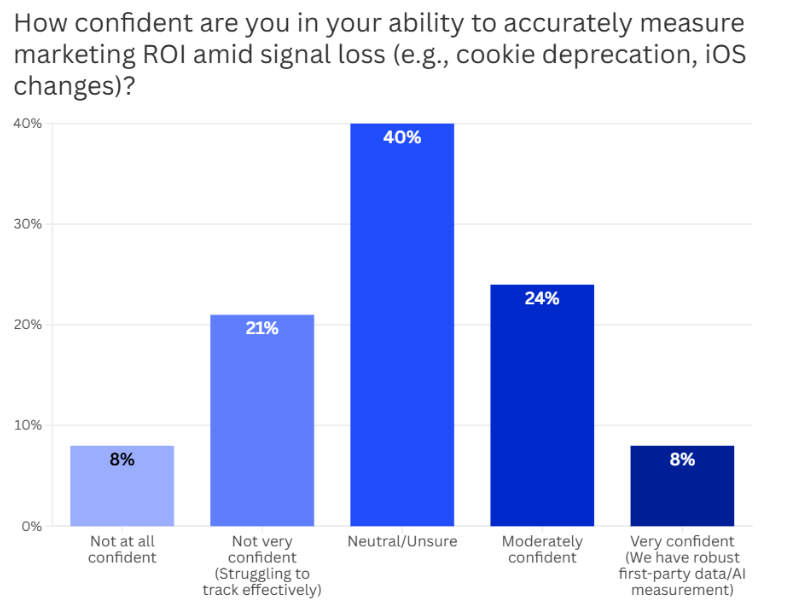
In short, most of the industry is operating with incomplete visibility.
1️⃣ Perfect Attribution Is No Longer Realistic: The era of fully trackable user journeys is over. Platform dashboards no longer tell the full story. Relying solely on reported ROAS creates a distorted view of performance.
2️⃣ First Party Data Is The New Advantage: The marketers who feel confident have typically invested early in collecting and organizing their own customer data. Owning the relationship with users makes measurement more resilient when external signals disappear.
3️⃣ Triangulation Replaces Single Source Truth: Instead of trusting one dashboard, compare platform reported results with the backend sales data in your CRM. Run incremental lift tests by turning campaigns on and off to measure real business impact. This layered approach reveals what actually drives revenue.
The Takeaway
Attribution will not return to its old clarity. The brands that adapt by strengthening first-party data and triangulating performance signals will make smarter decisions than those clinging to platform metrics alone. Confidence in tracking now depends on infrastructure, not optimism.
As we prepare more "Growthful" content, we'd love to hear your thoughts on today's edition! Feel free to share this with someone who would appreciate it. 🥰