The Trick Behind Better Offers
⚡ Understand why an improved offer can trigger more yeses, then use audio placement data to put your brand where attention is highest.

Hey there 🧠
Ready for another day of staying ahead of the competition in the Growth race?
Oh and before we go ahead! If your friend sent this to you, be sure to subscribe here! So you don’t miss out on any editions.
In Partnership with Upwork
Your team has never built an AI agent, and that's fine

Automation builds, RAG pipelines, data cleanup at scale. Most companies have nobody in-house who has done any of it.
Training someone takes a year. Hiring for it means a bidding war against companies that pay more than you do.
The third option is renting the expertise for one contained project and seeing how it goes before committing to anything bigger.
Upwork has specialists across more than 125 categories, including the ones that didn't exist in 2023.
Growth Pulse readers get a $50 Visa gift card after a first completed hire.
(Add this at end of the edition)
💡 Why “But Wait, There’s More” Still Works
Sometimes the easiest way to make an offer feel better is to improve it before the buyer has time to respond.
That’s the That’s-Not-All Technique: present an offer, then add a bonus or lower the price before the customer answers.
Here’s why it works.
1️⃣ The Extra Feels Like A Concession: In a classic bake-sale experiment, 40% bought when a cupcake and cookies were offered together.
When the cupcake was offered first and the cookies were added moments later, 73% bought.
2️⃣ The First Offer Becomes The Anchor: Once buyers hear the original price or package, they use it as a reference point.
The improved offer then feels more valuable by comparison.
3️⃣ Let The Offer Build: Infomercials made this famous by revealing the core product first, then adding relevant bonuses one after another before the call to action.
The key is keeping every extra connected to the original purchase.
4️⃣ Beat A Credible Expectation: Apple used a similar effect when Steve Jobs highlighted expectations of a $999 iPad before revealing the actual $499 starting price.
The contrast made the final offer feel dramatically stronger.
5️⃣ Don’t Fake The Bonus: The technique depends on goodwill.
Hidden fees or misleading “free” extras can destroy the trust that makes the tactic persuasive in the first place.
Why It Works
The improved offer creates both contrast and reciprocity.
Buyers feel they are receiving something extra, while the first offer makes the second look better.
The Takeaway
Don’t reveal everything at once.
Build the offer before the customer decides, but keep the bonus relevant, the anchor believable, and every cost transparent.
💡 Audio Ads Work Best Before And During The Content
Not every ad slot gets remembered equally.
Comscore data suggests listeners are far more likely to recall ads placed before or during audio content than ads placed at the end.
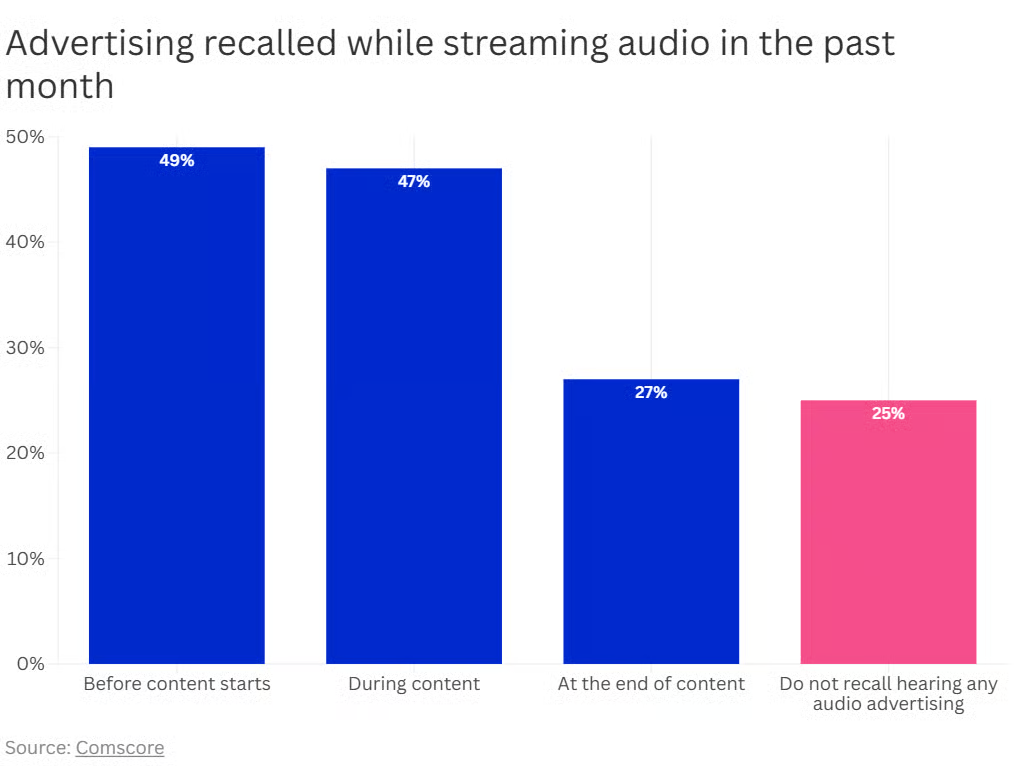
Here’s what the data shows.
1️⃣ Pre-Roll Leads Recall: Ads played before the content starts were remembered by 49% of listeners.
That gives brands a strong chance to be heard while attention is still fresh.
2️⃣ Mid-Roll Performs Almost As Well: Ads placed during the content reached 47% recall.
Listeners are already engaged, making mid-roll one of the strongest positions for audio advertising.
3️⃣ End-of-Content Ads Fall Behind: Post-roll ads were remembered by only 27%.
By the time the episode or stream ends, many listeners may already be skipping, closing the app, or moving on.
4️⃣ Some Listeners Remember Nothing: Around a quarter of listeners said they did not recall hearing any audio ads at all.
That makes strong creative and early brand identification even more important.
5️⃣ Placement Still Needs Context: Publishers often sell fewer post-roll placements, so lower recall does not automatically mean those slots have no value.
But they are better suited for lower-cost reinforcement than primary campaign impact.
Why It Works
Attention is highest when content begins and while listeners are actively engaged.
Once the content ends, attention drops quickly.
The Takeaway
Prioritize pre-roll and mid-roll placements for important campaigns.
And mention your brand early, so even listeners who skip still hear who the ad is from.
*$50 Visa gift card issued after your first completed hire. New clients only. Terms apply.
As we prepare more "Growthful" content, we'd love to hear your thoughts on today's edition! Feel free to share this with someone who would appreciate it. 🥰