The Measurement Gap In Influencer Marketing
🎯 Discover why brands are boosting creator content for cleaner data, then see why retail AI works better as a helper than a replacement.

Hey there 🧠
Ready for another day of staying ahead of the competition in the Growth race?
Oh and before we go ahead! If your friend sent this to you, be sure to subscribe here! So you don’t miss out on any editions.
In Partnership with Omnisend
One Plain-Text Email Outearned a Month of Campaigns
Before you send everyone the same BFCM discount, check who keeps coming back. Your repeat buyers could justify an offer of their own.
For one skincare brand, 36% of customers had ordered more than six times. Enflow Digital used Omnisend to turn that loyalty into nearly $18,000 from one plain-text email.
Omnisend helped the team:
- Find purchase patterns in minutes, cutting out hours of manual analysis.
- Build a VIP audience of customers with four or more orders, ready for a separate promotion.
- Keep the VIP offer focused on engaged buyers by filtering out contacts inactive for 180 days.
The offer was available only through email: a higher discount plus a gift above a higher spend threshold. It increased order value while helping clear slower-selling stock.
Co-founder Karolina shares how it came together so you can apply the approach to your own repeat buyers before your BFCM offers are locked in.
💡 Influencer Marketing Has A Measurement Problem
Creator campaigns can generate attention across multiple platforms.
The problem is that each platform measures that attention differently, making performance difficult to compare.
Here’s what the data shows.
1️⃣ Measurement Is The Biggest Challenge: Around two-thirds of marketers in an ANA influencer report said measurement is their hardest influencer-marketing problem.
That puts it well ahead of creator vetting, negotiation, contracting, and discovery.
2️⃣ The Same Metrics Mean Different Things: Instagram, TikTok, and YouTube define views, reach, engagement, and completion differently.
There is also no reliable standard for removing audience overlap across platforms, so simply adding the numbers together can be misleading.
3️⃣ Paid Boosting Creates Cleaner Data: More brands are putting paid spend behind creator content because paid campaigns offer stronger attribution and reporting.
EMARKETER expects US creator boosting spend to reach roughly $14.2 billion in 2027, matching sponsorship revenue.
4️⃣ Plan Usage Rights Upfront: If a creator post performs well, brands may want to boost it or run ads from the creator’s handle.
Including paid usage rights and whitelisting terms in the original contract avoids renegotiation later.
5️⃣ Choose The Goal Before The Creator: Decide whether the campaign is meant to drive awareness, sales, or conversions before launch.
Then select creators and reporting metrics around that objective.
Why It Works
Better measurement starts with clearer goals and more consistent data.
Paid amplification gives brands more control over reporting while still leveraging the credibility of creator content.
The Takeaway
Don’t treat every creator metric as comparable.
Define the outcome first, secure the right usage rights, and use paid amplification when you need cleaner measurement.
💡 Most Shoppers Still Aren’t Ready To Chat With Your Store
Retailers are adding AI shopping assistants fast.
Shoppers are adopting them much more slowly.
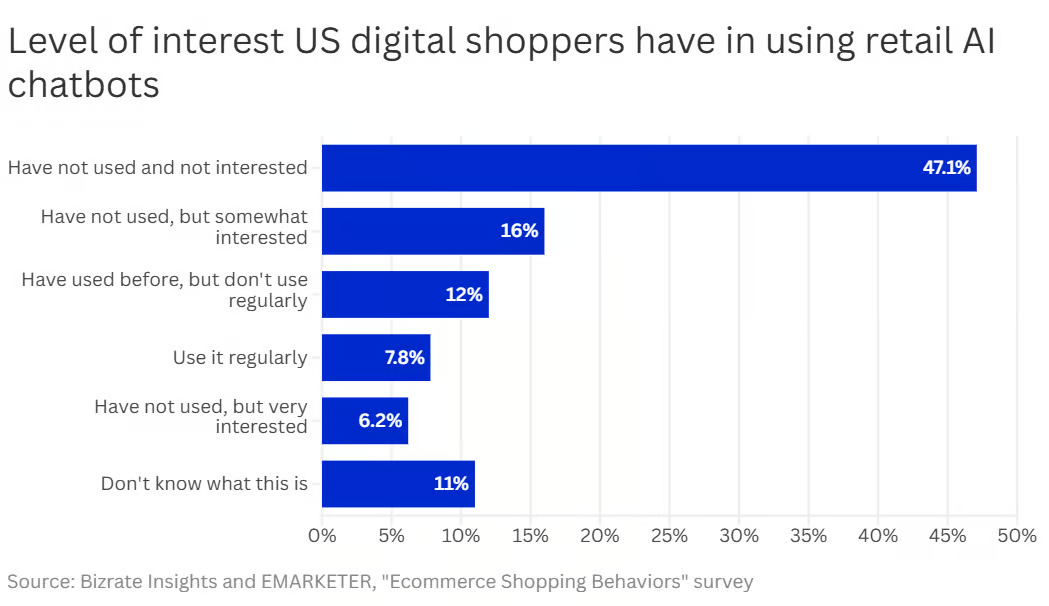
Here’s what the data shows.
1️⃣ Nearly Half Aren’t Interested: 47.1% of US digital shoppers say they have never used a retail chatbot and have no interest in trying one.
Another 11% don’t know what a retail chatbot is.
2️⃣ Regular Usage Is Still Low: Only 7.8% say they use retail chatbots regularly.
Another 12% have tried one but don’t use it often, which suggests many shoppers still prefer familiar discovery tools.
3️⃣ There Is A Curious Middle: 22.2% haven’t used a retail chatbot yet but say they are interested.
That group is larger than all current users combined, making it the clearest growth opportunity.
4️⃣ Search And Filters Still Feel Easier: Shoppers already understand search bars, categories, and filters.
A chatbot adds another interaction layer, and years of frustrating customer-service bots may make people cautious about using one for shopping.
5️⃣ Use Chatbots Where They Add Value: Don’t force AI into every shopping journey.
Place assistants at moments where conversation helps, such as gift discovery, product comparison, sizing help, or narrowing a large catalog.
Why It Works
New shopping tools gain adoption when they remove friction rather than create it.
If a chatbot makes a task easier than search, people have a reason to use it.
The Takeaway
Don’t replace search with chat.
Use AI assistants alongside familiar tools and introduce them where conversation genuinely improves the buying experience.
As we prepare more "Growthful" content, we'd love to hear your thoughts on today's edition! Feel free to share this with someone who would appreciate it. 🥰