The Hybrid Marketer Era
📉 Writing is not enough anymore, and your research habit is lying to you.

Hey there 🧠
Ready for another day of staying ahead of the competition in the Growth race?
Oh and before we go ahead! If your friend sent this to you, be sure to subscribe here! So you don’t miss out on any editions.
Partnership with Syncly
The conversations you’re not seeing are costing you.
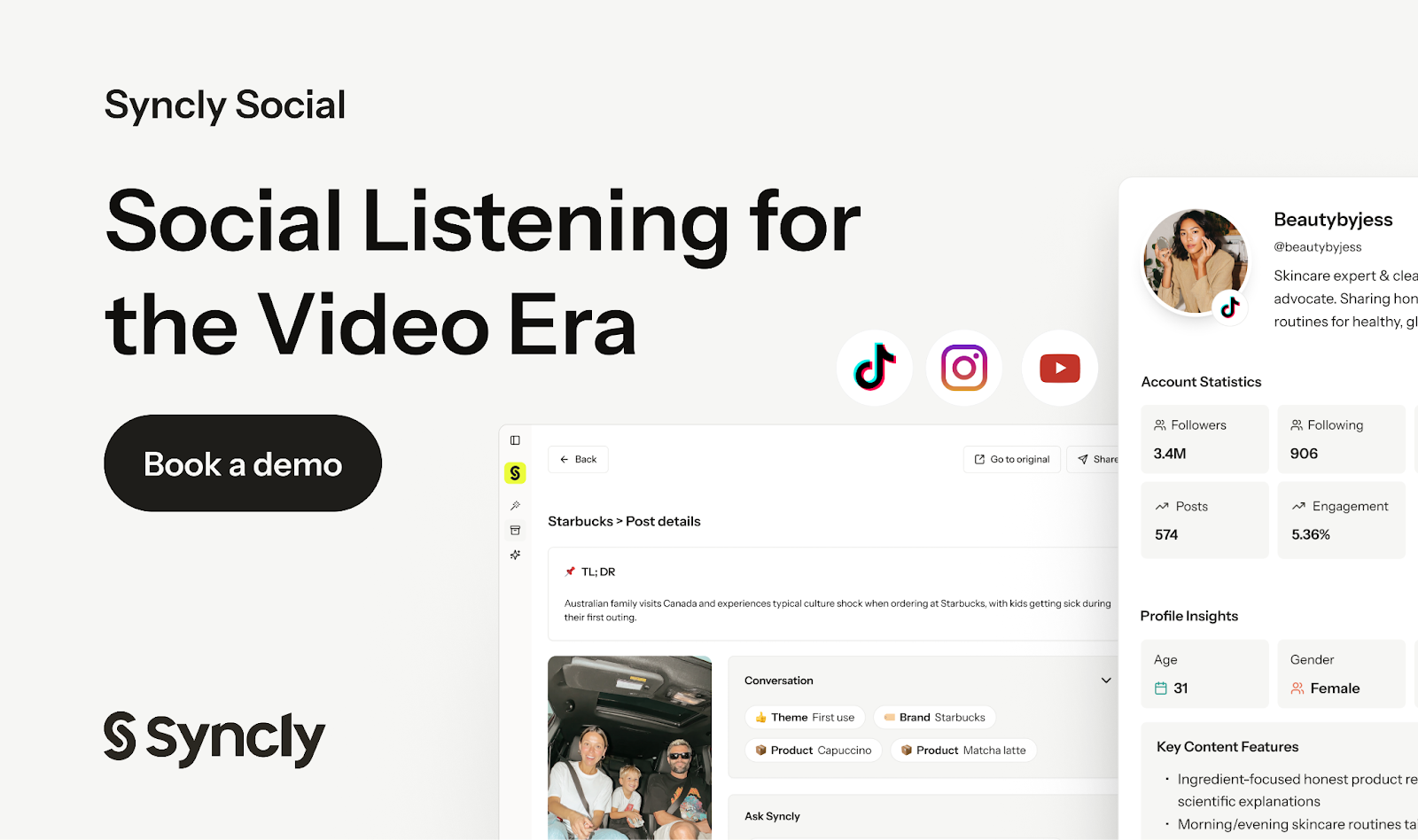
If you’re still relying on text-based listening in 2026, you’re running your brand half-blind.
Most tools miss everything that actually moves culture, the spoken mentions, the untagged endorsements, the moments inside the video that shape perception long before comments do. And by the time something hits your feed, the damage is already done.
Syncly Social lets you finally hear what they say and see what they show in one place.
- Spot spoken brand mentions across TikTok, IG, and YouTube in real time.
- See untagged creators pushing your product before your competitors do.
- Decode exactly who is representing your brand with demographic insights.
- Track competitor momentum through the videos driving their growth.
Top brands like Kosas, Burberry, and Calvin Klein use Syncly Social because it reveals the conversations that move their brand the second it happens.
The after-state is simple: nothing slips past you again. You hear what they say, you see what they show, and you move faster than the narrative.
Get started for free and give your brand the visibility it never had!
💡 Content Marketing Is Shifting From Writing To Ownership
Being good with words is no longer enough. Now you are expected to own the machine.
An analysis of 8,000 content marketing job listings shows a clear shift. The industry is becoming more technical, more strategic, and far less forgiving for “just writers.”
Here is what is changing.
1️⃣ The Market Is Splitting In Two: Demand for mid-level content roles has dropped by over 70 percent since 2023. Companies now want either content producers who execute consistently or Heads of Content who build and manage the entire system. The middle layer is shrinking fast.
2️⃣ Writing Is No Longer The Core Skill: Job listings mentioning pure “writing” have dropped by 28 percent, while “content creation” has surged by more than 200 percent. Content now includes video, distribution, SEO, analytics, and repurposing. SEO is no longer a specialist add-on. It is assumed.
3️⃣ Data And Storytelling Are Becoming Central: Data collection responsibilities in senior roles have jumped by 369 percent. At the same time, storytelling remains a top requirement. Companies want professionals who can interpret numbers and turn them into compelling narratives that stand out from generic AI output.
4️⃣ AI Literacy Is Expected: AI knowledge appears in 34 percent of senior roles and 20 percent of execution roles. You are not expected to be an AI engineer, but you are expected to understand how to collaborate with language models and integrate them into workflows.
5️⃣ Technical Backgrounds Are Rising: Traditional liberal arts requirements are declining. English and Journalism degree mentions have dropped significantly, while Business and Computer Science backgrounds are increasing in demand, especially for leadership roles.
The Takeaway
Content marketing is evolving from writing articles to owning systems. To thrive, you need to combine analytics, distribution strategy, AI fluency, and storytelling. The future belongs to hybrid marketers who can build and operate the full engine, not just draft the copy.
💡 Information Bias: Why Research Feels Like Progress
You’ve consumed the guides. I watched the breakdowns. Saved the templates.
But you still haven’t launched.
That’s information bias. The tendency to seek more data even when it won’t change the decision. Research shows people request irrelevant information simply because gathering it feels productive. The brain mistakes research for action.
Here is how this bias plays out and how to use it wisely.
1️⃣ Understand The Research Trap: A study in Organizational Behavior and Human Decision Processes found that people seek additional diagnostic data even when it does not affect outcomes. In marketing terms, that means reading one more case study instead of pressing publish. Data collection feels safe. Execution feels risky.
2️⃣ Leverage Comparison Content Strategically: Buyers crave reassurance. Comparison pages satisfy that hunger. Brands like Klaviyo build detailed competitor comparisons with feature tables, pricing breakdowns, and migration guides. They create a controlled research path that leads back to their solution.
3️⃣ Stack Structured Proof To Remove Doubt: More information closes deals when it reduces uncertainty. Notion layers use cases, industry logos, and segmented testimonials. E-commerce brands stack durability tests, specifications, and thousands of reviews. The goal is not noise, but targeted reassurance.
4️⃣ Recognize When You Are Stalling: Marketers fall into the same trap. Endless SEO guides, PPC tutorials, competitor audits. Research feels like momentum. It is often avoided. If additional data will not change your decision, it is time to act.
5️⃣ Replace Consumption With Testing: Information reduces uncertainty. Action produces clarity. Instead of consuming one more framework, launch the campaign, ship the landing page, or run the experiment. Feedback beats theory every time.
The Takeaway
Information bias makes research addictive. Used strategically, it reassures buyers and increases conversions. Used carelessly, it delays execution. The difference is intent. Know when to feed the bias and when to close the tabs.
As we prepare more "Growthful" content, we'd love to hear your thoughts on today's edition! Feel free to share this with someone who would appreciate it. 🥰