Test Your AI Visibility
🧠 Diagnose hidden AI search visibility issues, then learn why authentic perspective may be the next competitive moat.

Hey there 🧠
Ready for another day of staying ahead of the competition in the Growth race?
Oh and before we go ahead! If your friend sent this to you, be sure to subscribe here! So you don’t miss out on any editions.
In Partnership with Billo
Get Meta’s Take Before Your Next Ad Test
Everyone has advice on what works in Meta ads. You’re the one paying when it doesn’t.
Get closer to the source before another campaign turns someone else’s theory into your expense.
On October 7 at 11:00 AM ET, Billo CEO Donatas Smailys hosts a free, 60-minute live session featuring Reyna Baker, Partner Manager at Meta.
You’ll get direct access to:
- Meta’s own data explaining why creator-handle ads are outperforming brand creative, so you can assess what Partnership Ads could bring to your account.
- Creative testing lessons from Curtis Howland, VP of Marketing at Misfit Marketing, who has managed $100M+ in Meta spend.
- Examples of how a marketing lead and an agency founder are scaling creator ads, giving you approaches to adapt to your campaigns.
You’ll leave knowing what to test with creator ads next, backed by Meta’s data and lessons from teams already running them.
Can't attend the session live? Register anyway, and you’ll get the recordings in 24 hours.
💡 A 20-Second Test Can Show If AI Search Sees Your Page
Ranking in AI search starts with one basic question.
Can the system actually retrieve your page in the first place?
There’s a simple way to test that without any special tool.
Here’s how to do it.
1️⃣ Pick A Unique Passage From Your Page: Choose a meaningful 20–30 word snippet from the page you want to test.
Use text with names, numbers, specific phrases, or uncommon wording. Generic marketing copy is harder to isolate because similar language may appear across many websites.
2️⃣ Make The Chatbot Search For It: Ask the chatbot to search for that exact passage and return only results containing the same text.
If your URL appears, it’s a strong signal that the search source behind the chatbot can retrieve your content and correctly associate it with your page.
3️⃣ A Match Tells You Three Things: If your page comes back, it suggests the content is available to the search source, the text is attributed to the correct URL, and the page is technically accessible enough to be retrieved.
That doesn’t guarantee the page will be cited in AI answers, but it confirms you’ve cleared the first hurdle.
4️⃣ If It Fails, Check The Basics: A miss can point to familiar technical SEO issues.
Look for orphaned pages, robots.txt or firewall blocks, noindex directives, incorrect canonical tags, rendering problems, text-extraction failures, or content that may be too thin to index properly.
5️⃣ Test More Than Once: Don’t treat one failed search as definitive.
AI systems can pull from different sources across different runs, and newly published pages may take time to become retrievable. Test several times and try different unique snippets before drawing a conclusion.
Why It Works
AI search still depends on content being discoverable and retrievable before it can be surfaced in an answer.
This test gives you a quick way to identify whether the problem starts with technical visibility before you spend time trying to improve citations or AI rankings.
The Takeaway
You can’t earn AI visibility if the system can’t retrieve your page.
Before worrying about citations, rankings, or AI optimization, confirm that your content is actually accessible
💡 Big Brands Are Optimizing For Robots. Smaller Brands Are Winning Humans
Content strategy is starting to split by company size.
Larger companies are focusing more on search engines and AI systems, while smaller businesses are still prioritizing direct human connection.
Here’s what the data shows.
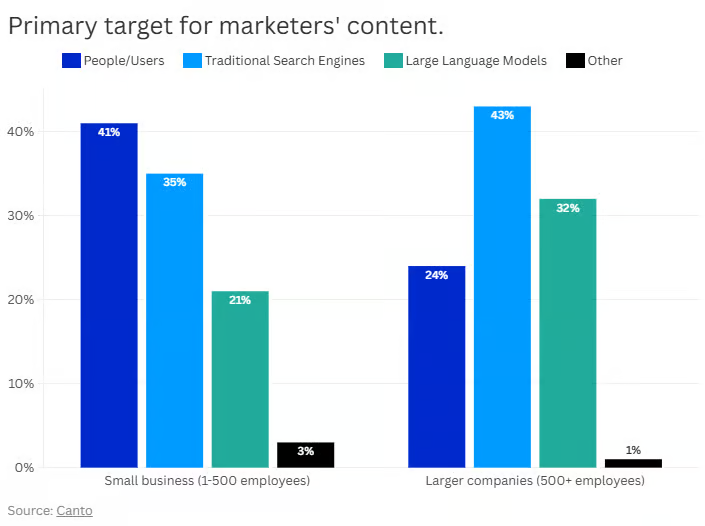
1️⃣ Small Businesses Focus More On People: Among companies with 1–500 employees, 41% prioritize direct engagement with users.
That compares with only 24% of larger companies, suggesting smaller brands are leaning more heavily on human connection, personality, and audience relationships.
2️⃣ Large Companies Are Chasing Discoverability: Companies with more than 500 employees are putting more emphasis on machines.
Around 43% prioritize traditional search engines, while 32% are creating content specifically to influence Large Language Models and AI-generated answers.
The goal is simple: be discovered wherever customers are searching.
3️⃣ AI And Search Still Matter For Smaller Brands: Smaller businesses aren’t ignoring algorithms entirely.
Around 35% focus on search engines, while 21% are optimizing for LLMs. But both remain secondary to reaching people directly.
4️⃣ The Strategies Reflect Different Advantages: Large brands can compete through scale, authority, distribution, and visibility across search and AI platforms.
Smaller brands often have a different advantage: they can sound more personal, specific, opinionated, and relatable than larger organizations.
5️⃣ Opinionated Content Becomes The Opportunity: Search engines and AI systems tend to reward useful, accurate, and broadly relevant information.
But audiences often remember content with a distinct perspective. For smaller brands, strong opinions, firsthand experience, and recognizable personality can create differentiation that generic information cannot.
Why It Works
People have unlimited access to information.
What remains scarce is perspective.
Brands that combine useful information with a recognizable point of view can create stronger audience relationships while still remaining discoverable through search and AI.
The Takeaway
You don’t have to choose between humans and algorithms.
But smaller brands shouldn’t sacrifice personality just to sound optimized. Use search and AI to get discovered, then give people a reason to remember who created the content.
As we prepare more "Growthful" content, we'd love to hear your thoughts on today's edition! Feel free to share this with someone who would appreciate it. 🥰