Smarter Meta Ads For Locals
🎯 See what local businesses should actually optimize on Meta, hen discover why email is holding its ground as other channels slip.

Hey there 🧠
Ready for another day of staying ahead of the competition in the Growth race?
Oh and before we go ahead! If your friend sent this to you, be sure to subscribe here! So you don’t miss out on any editions.
In Partnership with Omnisend
Your BFCM Plan Is Still Waiting on Better Prompts
How much time goes into pulling last year’s reports and explaining them to AI? If every useful answer takes another round of clarification, your BFCM prep barely moves forward.
Omnisend’s BFCM AI playbook gives you detailed prompts for the work you need to get done, so you can spend less time figuring out what to ask.
Use last year’s results to decide which campaigns deserve another run and check deliverability before increasing send volume.
Then turn those findings into a campaign calendar your team can work from.
Better yet, Omnisend connects with Claude or ChatGPT, so you can analyze performance and create editable email templates without leaving the chat.
New to Omnisend? Its email and SMS platform serves 150,000+ ecommerce brands, reporting an average $79 for every $1 spent. Migration is free and takes up to five business days.
Start now, with time to put the answers to work.
💡 Meta Ads For Local Businesses: Fewer Tweaks, Better Ads
Local businesses often struggle with Meta Ads because audiences are smaller, budgets are tighter, and the real goal; foot traffic, is difficult to track.
The solution may be simpler than most advertisers think.
Here’s what to focus on.
1️⃣ Optimize For The Closest Conversion: If you can track purchases or leads, optimize for them directly.
If you can’t, use reach, ad recall lift, video views, or interactions. These aren’t perfect substitutes, but they help Meta focus on local visibility.
2️⃣ Check Breakdowns Before Changing Anything: Cheap engagement can sometimes attract people who are unlikely to become customers.
Before adjusting targeting, review demographic and placement breakdowns. Fix problems that the data actually confirms rather than reacting to assumptions.
3️⃣ Avoid Overusing Location Exclusions: Target a sensible radius around the business, but be careful with geographic exclusions.
Meta may include people who live in or recently visited an area, so aggressive exclusions can accidentally remove relevant local customers who travel.
Also review the setting that includes people simply interested in your location, especially if tourists are unlikely to become customers.
4️⃣ Trim Placements Only With Evidence: Removing placements can increase costs elsewhere.
Only restrict delivery when you can identify a clear performance problem rather than assuming certain placements are ineffective.
5️⃣ Let The Ad Do The Heavy Lifting: Settings can improve efficiency, but they won’t rescue a weak offer.
Your creative should speak directly to the customer’s problem, explain why your product is relevant, and give them a clear reason to act.
Why It Works
Local campaigns perform better when advertisers simplify targeting and focus on measurable customer actions.
The Takeaway
Don’t over-engineer local Meta campaigns.
Track what matters, diagnose problems before changing settings, and invest more effort into the offer and creativity.
💡 Search Is Getting Harder. Email Is Holding Up Better.
Driving attention online is becoming more difficult across almost every major channel.
But one channel appears to be holding up much better than the rest: email.
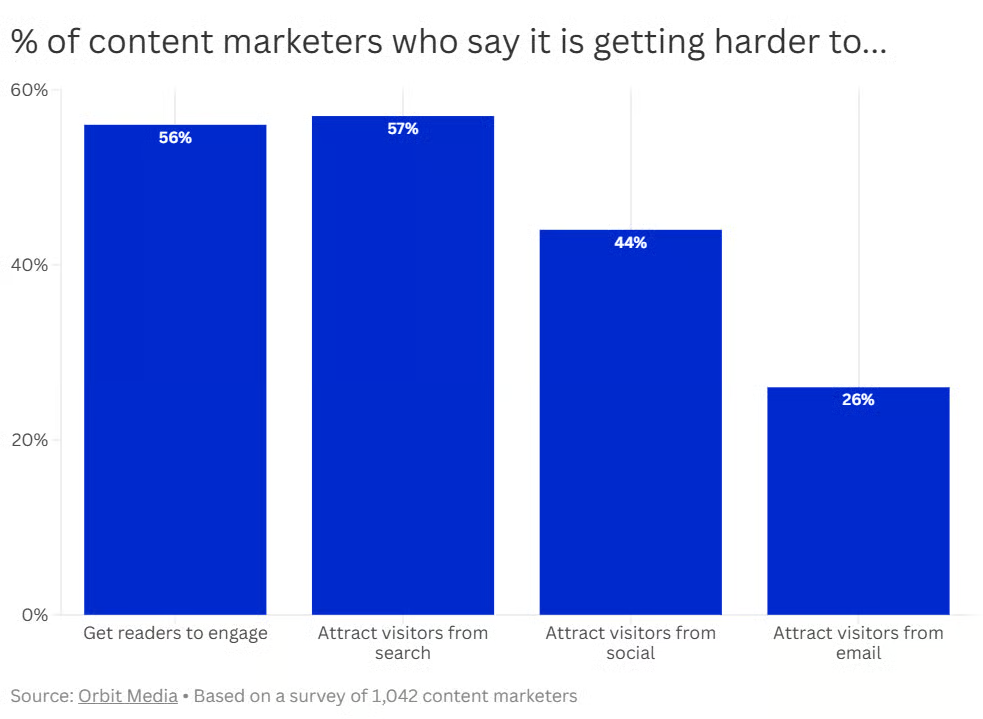
Here’s what the data shows.
1️⃣ Search Is Getting Harder: According to Orbit Media’s survey, 57% of content marketers say driving visitors from search is becoming more difficult.
AI answers, zero-click results, and changing search behavior are making organic traffic harder to earn.
2️⃣ Keeping Visitors Is Difficult Too: Even when people reach a website, 56% say keeping them engaged is a challenge.
Winning the click is only part of the problem. Brands also need content strong enough to hold attention once visitors arrive.
3️⃣ Social Isn’t Immune: Around 44% say attracting visitors from social media is difficult.
Algorithms determine how much reach content receives, which means brands have limited control over distribution.
4️⃣ Email Is Holding Up Better: Only 26% say driving traffic through email is difficult.
The difference is ownership. Search and social depend on platforms that can change their rules at any time, while email gives brands direct access to subscribers.
5️⃣ Turn Rented Traffic Into Owned Audience: Use search and social to attract attention, then convert that traffic into email subscribers.
Place clear sign-up opportunities on your strongest content and give subscribers something useful they cannot get elsewhere.
Why It Works
Email removes much of the platform dependency that affects search and social.
You control the list, the message, and when it gets delivered.
The Takeaway
Search and social media can still drive discovery.
But the smartest move is turning that borrowed attention into an audience you actually own.
As we prepare more "Growthful" content, we'd love to hear your thoughts on today's edition! Feel free to share this with someone who would appreciate it. 🥰