Scarcity That Actually Converts
🧠 First you feel the rush of scarcity, and then you surrender to trusted recommendation.

Hey there 🧠
Ready for another day of staying ahead of the competition in the Growth race?
Oh and before we go ahead! If your friend sent this to you, be sure to subscribe here! So you don’t miss out on any editions.
Partnership with Galactic Fed
The team behind $300M in ad spend just freed up 20 minutes for you.

You're not losing because your product is worse. You're losing because someone else got a better read on their numbers first, and now they're outspending you on the channels that actually convert.
That gap compounds fast.
Galactic Fed audits your site and marketing, then hands you a custom growth plan built from managing millions in spend across 600+ brands. Real people. Real research. Not a template.
- Rustic Dime cut cost-per-purchase by 53% and grew purchases 305% with Meta Ads
- Slatkin + Co. hit a 43x increase in sales and 3,605% revenue growth through email
- Crowd Cow grew revenue 137% and customer acquisition 122% through email
Your 20-minute session includes a full channel audit, competitor breakdown, conversion fixes, and a growth roadmap built for your store.
It's free, personalized, and slots are limited to 10.
💡 How Demand-Based Scarcity Drives Conversions
“Only 2 rooms left at this price.”
Your heart rate jumps. You click faster.
That is not coincidence. That is psychology.
Scarcity works because our brains use a shortcut. If something is rare, it must be valuable. But not all scarcity works equally. The type and timing matter.
Here is what the research shows.
1️⃣ Demand-Based Scarcity Works Best For Products:
A large meta-analysis across 131 studies found scarcity consistently boosts purchase intent. But demand-based scarcity, where others are actively buying, performs especially well for utilitarian products.
“Booked 15 times today” feels different from “limited stock.”
It signals competition, not just restriction.
2️⃣ Trust Determines Whether Scarcity Converts Or Backfires:
If brand trust is low, scarcity feels manipulative. If trust is strong, scarcity feels urgent and legitimate.
Glossier built community and credibility before launching limited drops. When scarcity arrived, customers begged for restocks instead of questioning authenticity.
Constraint works best when reputation protects it.
3️⃣ Scarcity Triggers Competitive Arousal:
Real-time signals like “Someone is viewing this” or “Only 2 left” activate perceived competition.
Research shows limited-time notices do not directly increase purchase intent. They increase competitive arousal, and that emotional spike drives action.
Scarcity builds the arena. Competition closes the sale.
4️⃣ Limit Access, Not Just Supply:
Monzo’s Golden Ticket system restricted invites to one per user. That constraint turned customers into gatekeepers.
Scarcity applied to access increases perceived exclusivity more than scarcity applied to inventory.
The Takeaway
Scarcity is not about slapping a countdown timer on your page.
Create demand first. Build trust second. Introduce constraint third.
When urgency is credible and competition feels real, hesitation disappears.
💡 Why Podcast Ads Are So Powerful
Insights from stackedmarketer
If someone has been in your ears during every commute and workout for three years…
Their recommendation does not feel like an ad. It feels like advice.
Podcast advertising works because it runs on trust.
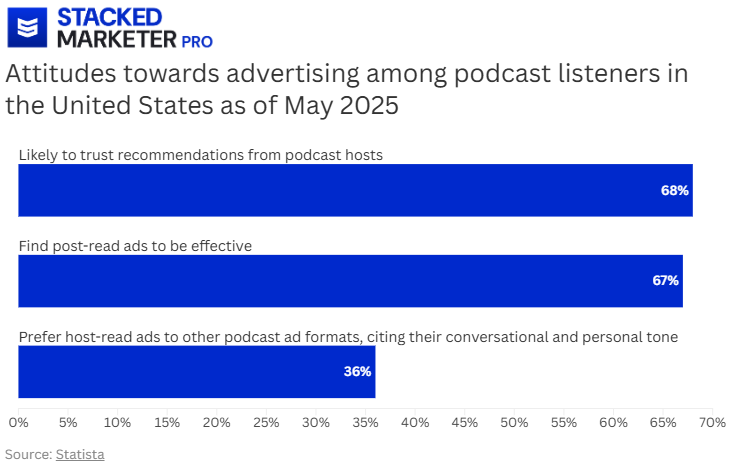
Here is what the numbers reveal.
1️⃣ Trust Levels Are Extremely High:
68% of listeners say they trust recommendations from podcast hosts. That is not passive awareness. That is influence.
2️⃣ Format Drives Effectiveness:
67% find post-roll ads effective, while 36% explicitly prefer host-read ads for their conversational tone.
The delivery matters. A polished, pre-recorded radio-style ad cannot compete with a host casually saying, “I actually use this.”
3️⃣ Parasocial Relationships Do The Heavy Lifting:
Listeners spend hours with hosts during workouts, commutes, and daily routines. Over time, this builds what psychologists call a parasocial relationship.
It feels personal, even though it is one-sided.
When a host reads your sponsorship, they are not just delivering copy. They are lending their reputation.
4️⃣ Why It Feels Different From Other Channels:
Display ads interrupt. Social feeds feel noisy. Podcast ads feel integrated into trusted content.
It is the difference between being pitched and being recommended.
5️⃣ How To Make It Work:
Skip generic audio spots. Invest in host-read sponsorships. Allow room for improvisation and personal stories.
Authenticity increases recall and conversion.
The Takeaway
Podcast ads are not just media placements. They are trust transfers.
When you align with the right host, you do not just buy attention. You borrow credibility.
As we prepare more "Growthful" content, we'd love to hear your thoughts on today's edition! Feel free to share this with someone who would appreciate it. 🥰