Rethink your Meta budget
📊 How to calculate your Meta ads budget, and how users really use AI

Hey there 🧠
Ready for another day of staying ahead of the competition in the Growth race?
Oh and before we go ahead! If your friend sent this to you, be sure to subscribe here! So you don’t miss out on any editions.
Partnership with Grapevine
The UGC Engine That Quietly Beats Your Ads
Branded creative looks incredible in a deck, but Q1 is where it quietly stops paying for itself. CPAs creep up, testing slows down, and every “pretty” ad becomes a bet you can’t afford to keep making.
Grapevine solves that with a done-for-you UGC engine designed to outperform the ads you’re running now quietly. No chasing creators. No contract chaos. No wasted cycles.
Grapevine handles it all. Just authentic content plugged into your paid social flows, and the numbers prove it works.
- Editorial whitelisting campaigns reduced CPAs by up to 40%, unlocking immediate margin gains.
- Benchmarks confirm Grapevine ads outperform branded creative by 25%+ across platforms.
The after-state? Faster launches, cheaper acquisitions, and a UGC pipeline that compounds wins while your team focuses only on scale.
Book a strategy call by February 27th for $500 off your first campaign!
💡 How You Should Think About Your Meta Ads Budget
There is no magic Meta Ads budget. Unless it is unlimited.
As Jon Loomer explains, your budget should be built on math and business fundamentals, not hope or someone else’s success story.
Here is how to approach it strategically.
1️⃣ Start With The Right Goal: Cheap objectives like awareness or engagement feel productive, but they rarely drive revenue. Optimize for meaningful conversion events such as purchases or qualified leads. If purchases are too expensive initially, choose a strong middle ground that still signals real intent.
2️⃣ Be Conservative With Cost Assumptions: Ignore headline ROAS claims. Estimate your cost per goal action realistically. If you sell a $100 product, assume it may cost $100 to acquire a purchase until proven otherwise. Conservative planning protects cash flow and prevents unrealistic expectations.
3️⃣ Avoid Fragmenting Your Budget: Too many campaigns and ad sets dilute performance. When small budgets are split across multiple segments, none receive enough data to exit the learning phase efficiently. Consolidate spend into fewer ad sets to give Meta sufficient signal volume.
4️⃣ Calculate Based On Volume Requirements: Meta’s algorithm performs best with approximately 50 optimized actions per week per ad set. If your cost per action is $50, you need around $2,500 per week for stable performance. Falling short of this volume increases volatility.
5️⃣ Align Budget With Creative Strategy: Larger budgets allow for multiple creative tests and faster iteration. Smaller budgets require focus. Prioritize high-quality creatives instead of spreading thin across many variations.
6️⃣ Simplify When Resources Are Limited: If your math suggests a budget beyond your means, simplify your structure. One campaign and one ad set can outperform complex setups starved of data. If volume is still insufficient, consider optimizing for a lower cost event like leads.
7️⃣ Protect Your Capital: Do not scale beyond what your business can sustain. Sustainable growth beats aggressive overspending.
The Takeaway
Meta Ads budgets are not guesses. They are calculations tied to goals, cost assumptions, and required volume. Build your budget around data and business reality, and let structure support scale instead of sabotaging it.
💡 How Are Users Approaching Conversational AI
Insights from stackedmarketer
AI is no longer just a novelty. It is becoming a shortcut.
Users are increasingly turning to conversational AI to reduce effort and bypass long form reading. Instead of scanning entire articles, they want distilled answers fast.
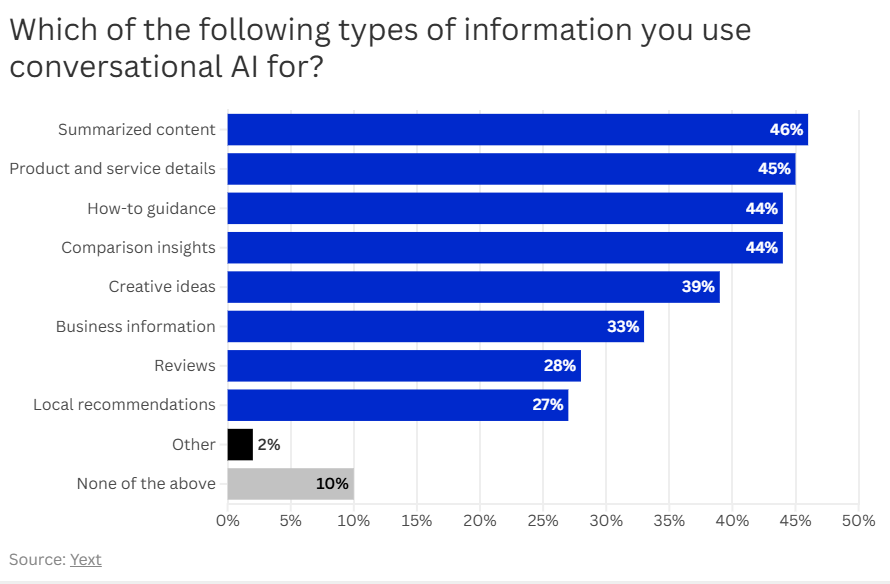
Here is what the data shows.
1️⃣ Efficiency Is The Primary Driver: The top use case for conversational AI is summarised content, with nearly half of users relying on it to cut through information overload. People want the core insight without the friction of scrolling.
2️⃣ AI Is Becoming A Pre-Purchase Advisor: Close behind summaries, users are asking AI for product and service details, as well as comparison insights. This positions AI as an early-stage decision maker in the buyer journey. If your brand is not part of those responses, you may never enter consideration.
3️⃣ Creative Support Is Growing Fast: A significant portion of users turn to AI for creative ideas. Brainstorming, drafting, and ideation are becoming default AI use cases, reducing barriers to content creation and problem solving.
What This Means For Your Content Strategy: If users want the gist without the click, your content must be structured for extraction. Long walls of text without summaries are increasingly invisible in AI driven discovery.
Add clear TLDR sections and concise bullet summaries at the top of long form content. When AI can easily parse and summarize your material, it is more likely to reference and cite it.
The Takeaway
Conversational AI is reshaping how information is consumed. The brands that structure content for clarity and summarization will remain visible in AI answers. Those that rely on dense, unstructured copy risk disappearing from the new discovery layer.
As we prepare more "Growthful" content, we'd love to hear your thoughts on today's edition! Feel free to share this with someone who would appreciate it. 🥰