AI Search Changes Ad Strategy
⚡ Learn how AI Mode changes the path from query to conversion, then understand why scaling the same audience can quietly push acquisition costs higher.

Hey there 🧠
Ready for another day of staying ahead of the competition in the Growth race?
Oh and before we go ahead! If your friend sent this to you, be sure to subscribe here! So you don’t miss out on any editions.
In Partnership with Insense
1 UGC creator = 20+ ad variations to scale your Q4 creatives
Insense makes UGC ads insanely cost-effective - and Andromeda-approved!
Meta's Andromeda update now rewards creative diversity (+22% ROAS), so the more distinct hooks and angles you test, the better you rank.
From one brief, get numerous raw footage clips to mix, match, and turn into multiple scroll-stopping creatives for your paid social ads.
Source 20+ pieces of raw content (per creator) with lifetime usage rights, all delivered in 14 days or less.
Here's the BFCM math: one winning ad takes 10-13 tested creatives, so 20+ variations per creator means more shots at a winner, and instant hook-swaps when an ad fatigues during BFCM week. Many versions from one shoot, not 50 shoots.
That’s how over 3,500 brands like Beauty Pie, Il Makiage, Revolut, and Monster Energy scale UGC without killing team bandwidth.
Cost-effective UGC with lifetime usage rights? Yes please!!
Book a free strategy call and get $200 toward your first campaign.
💡 AI Mode Searches Are Longer. Your Ads Need To Get More Specific.
Search behavior is getting more conversational.
In Google’s AI Mode, queries are around three times longer than traditional searches, which means advertisers need to answer more specific needs.
Here’s what to change.
1️⃣ Expect Longer, More Detailed Queries: People are moving beyond short keyword searches and asking full questions.
That means ads should reflect real problems, use cases, and context instead of relying only on broad category language.
2️⃣ Follow-Up Searches Matter: More searches do not always mean the first result failed.
Users often ask new questions after the first answer, which gives advertisers more opportunities to appear during the same research journey.
3️⃣ Review Negative Keywords Carefully: Search, Shopping, and Performance Max campaigns can appear in AI Mode follow-ups.
That makes keyword exclusions more important, especially as queries become longer and more varied.
4️⃣ Create For Early Research: Shoppers increasingly use search to understand a category before choosing a product.
Use stronger creative assets, comparisons, reviews, videos, and educational content to influence those earlier decisions.
5️⃣ Make The Landing Page Continue The Answer: Ads in AI Mode can match both the query and Google’s response.
Your landing page should pick up where that answer stops, with specific pain-point messaging, useful details, and minimal friction.
Why It Works
Longer queries reveal more intent.
Advertisers that respond to that detail can create a more relevant path from search to click to conversion.
The Takeaway
Don’t advertise to keywords alone.
Advertise to the full question the customer is asking.
💡 More Ad Budget Often Goes To The Same People
When advertisers get more budget, most don’t rush to find new audiences.
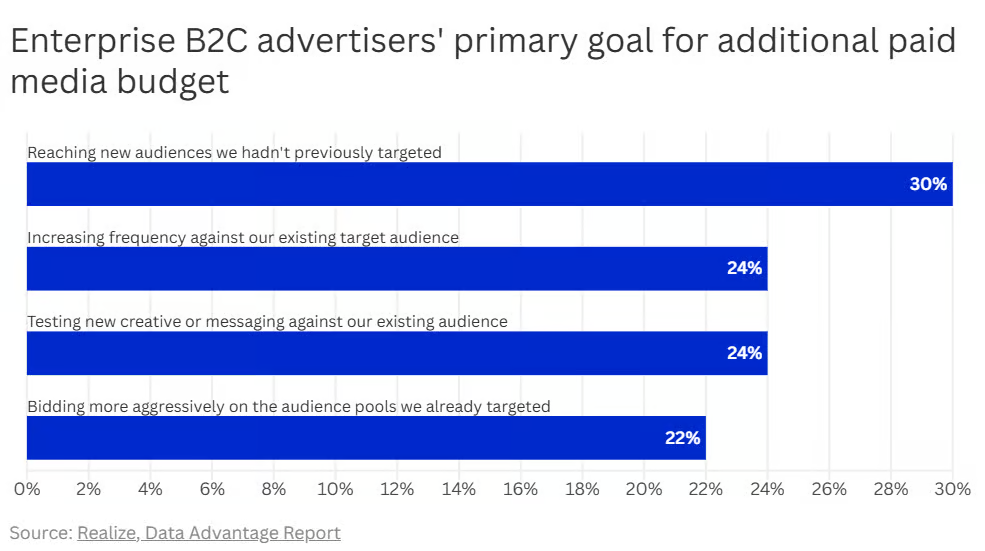
A recent survey of enterprise B2C advertisers found that only 30% would prioritize reaching new people.
Here’s what the data shows.
1️⃣ New Audience Growth Barely Leads: Reaching new audiences ranked first at 30%.
But that also means 70% of advertisers would spend extra budget on people they already target.
2️⃣ Most Would Increase Pressure On Existing Audiences: 24% would raise ad frequency, another 24% would test new creative or messaging, and 22% would bid more aggressively.
The strategies differ, but the audience stays largely the same.
3️⃣ Familiar Audiences Feel Safer: Existing audiences come with more historical data and easier attribution.
That makes them attractive when marketers need predictable short-term results.
4️⃣ More Spend Can Create Diminishing Returns: Increasing bids or frequency against the same people can push costs higher without producing proportional gains.
Once frequency rises and CPA worsens, saturation may be setting in.
5️⃣ Use New Budget To Test Reach: If your core audience is showing signs of fatigue, move part of the incremental budget into prospecting.
Compare performance against a holdout group so you can see whether broader reach actually creates incremental growth.
Why It Works
Scaling the same audience eventually gets more expensive.
Growth often requires balancing efficiency from known audiences with expansion into new ones.
The Takeaway
Don’t automatically spend more on the people you already know.
Watch frequency and CPA, then use extra budget to test whether new audiences can unlock better incremental growth.
As we prepare more "Growthful" content, we'd love to hear your thoughts on today's edition! Feel free to share this with someone who would appreciate it. 🥰